.

.
Showing posts with label Tin Dog. Show all posts

Thursday, 14 January 2016

Tin Dog's Latvia Lithuania Travelogue

Every now and then, I drag poor Tin Dog and any other fools I can find to foreign lands such as Chernobyl for a bit of "Boys Own" and an explore.

Well, over again to the ever wordy guest writer Tin Dog....


Latvia and Lithuania 2015

The Plan


For the first time ever there was a plan. We even had printed cheat sheets, lest we fell through the looking glass and got split up.

Tbolt, Frag and I were to fly to Riga, pick up a car and meet Darmon, then drive through Latvia and Lithuania whilst behaving sensibly at all times.

We had an itinerary. We had two satellite navigation devices that frequently disagreed. We had short memories of debacle’s past.

Frag had packed Fish and Chip snacks and a travel plug.

We’d only met Tbolt once, briefly, in a horrible coffee chain. Darmon was travelling from Bulgaria to meet us in a junkyard.

What could go wrong?

Riga 1

Arriving at the first hotel in Riga, Frag was sure that the suit of armour in the entrance was a good sign. He likes a suit of armour, does Frag. I daren’t ask why.

Untitled

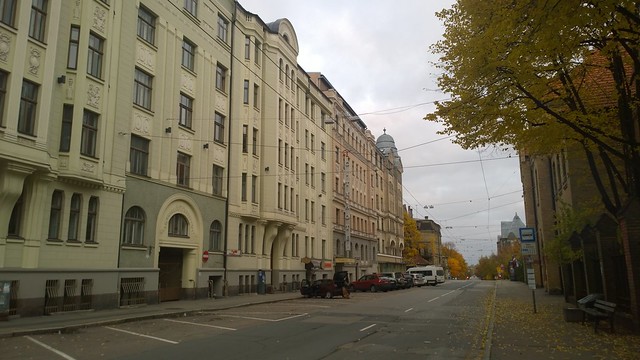
We had a quick beer in the bar next to the hotel and decided to push out into party central. We didn’t walk far. We didn’t need to. It was soon clear that this part of Riga shuts early on a Saturday night. It was cold, dark and grey and lit by sickly neon.

The streets were mostly empty and lifeless by eleven, save for litter being collected in corners by a light, cold wind. The town with no cheer, where occasional well wrapped Latvians scurried home to their city flats.

A half hearted search uncovered a tiny, unfriendly bar, used by surly, vodka smeared youths. They drank shots and stared a lot. They wore quilted jackets and angry, creased foreheads.

We sank a couple of strange beers and retired for an unnecessarily early start.


Take the Wheel


The gears gave a metallic grind and shrieked as they sheared. The car lurched and we pulled away through the car park almost skimming a large, arrogantly parked Mercedes.

Tbolt and I had, kindly, allowed Frag the first go at not getting us all killed in a car accident. I don’t think that Frag has had such a thrilling hour in a long time. Not one he’d want to repeat, anyway.

To make it easy, Frag had set his sat nav on the case. Take me to the junkyard. It was a high tech solution to dilute our cluelessness.

The sat nav was set to ‘surfer dude’ voice to annoy Frag’s daughter back home. We found him annoying in Latvia too. Corey had lost his ready audience and our good will whilst we slid, tentatively, into moving airport traffic. If he was real, he’d have to be able to take a punch, would Corey. It became hugely irritating immediately.

“Turn left, dude! That’s your left, dude, not mine!”

There was no left turn and Frag pressed his face into the windscreen in concentration.

Corey delivered every line as a Californian exclamation. Even in our panicked state, surfer pseud became annoying.

‘Make a u-turn. Don’t use the handbrake, dude!’

Frag was doing steady work through all this distraction, unlike the sat nav. It sent us in an ever more annoying series of circles, through empty housing developments, farms, down tracks and around and around ring roads.

We went around so many times that pedestrians, minding their own business, began to think we were stalking them.

An elderly man on an empty road broke into a staggering run on our third time around in twenty minutes. Maybe he was just late?

We were trying to find an aircraft junkyard on the outskirts of Riga airport. Where else would you meet an Englishman living in Bulgaria?

Frag, in an understandable state of fizz, parked up on a long straight road next to the junkyard. He’d had enough excitement. He almost threw the keys at us, thinking his ordeal was over. He was immediately confronted by the police pulling up along side us. They shouted and pointed and frowned.

“Move or we’ll arrest you.” was my guess. Statements like that don’t need interpretation.

Reigning in the frustration, Frag recovered his inner chap and found the nearest available car park. We parked up in a car park so vast that we kidded ourselves we would remember where we left the car, without bickering.


One Man’s Junk


It was a cold, damp autumn morning to be poking around a junkyard. We rang the bell and a guy with a greying beard, who looked like he might hang around in a junkyard, opened the gate to his junkyard.

My colleagues unleashed their cameras. Admittedly it was a hell of a junkyard. A Soviet Top Trumps of a spread.

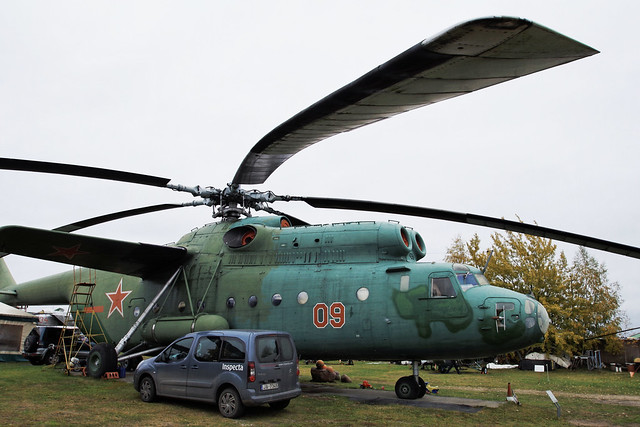
The helicopter in the centre was a troop carrying attack craft. Several sizes larger than a really big elephant, it could hold 5 crew and 65 to 90 troops. It was enormous. The rotors drooped under their own weight. It had stubby wings.
IMGP1423_DxO

Tbolt commented, “Can you imagine these rotors turning and the thing taking off?”

It must have been astonishing and frightening and exciting and deafening.

We climbed the rickety ladder and squeezed through the thin aisle, between a Cold War car boot sale of Russian uniforms, (really) great coats, boots, fur lined flying jackets, reel to reel recorders and all of it smelled of damp decay. The cockpit was tiny. Two tiny chairs with two levers, one each. A knee bruising dash of dials completed the cramped cockpit.

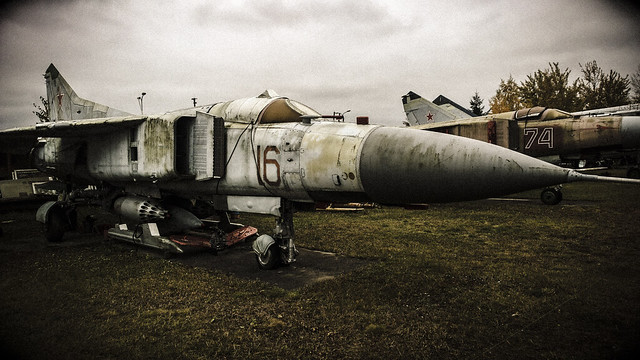
Nearby, MIG fighters were ranged in a line. Broken, supply helicopters and bomb casings lined up for inspection. Sleek, point nosed fighters and those swept wing reconnaissance planes that flew at the edge of space sat dripping dew and rust. All the machinery that we imagined would be coming over the horizon very soon, in the 1970’s and 80’s.
Soviet Aircraft Graveyard

The war ware from the Union of Soviet Socialist Republics; redundant, dated and slowly rusting into muddy ground. The villains in every film I ever saw as a child. It’s what we were told.

The gate buzzer sounded and the bearded keeper of this compound swung open the gate. Frag and a hung-over Darmon exchanged a handshake and muttered. The last of us to arrive was on board.


Searching For Skrunda 


To the west of Riga hides an abandoned Soviet city. Skrunda One was a military town built in the 1960’s and abandoned by the Russians in the 90’s. The town only existed to service two enormous RADAR installations. They were exploded thoroughly, before the Russians finally left the town to itself in 1998.

Our sat navs kept pointing out a right turn onto a track, in 2 miles, in 1 mile, in 800 yards. The road was straight and empty. No turnings.

The Latvian autumn was an art installation especially for us, framed by the windscreen.

A turn off track only became apparent because a car was parked up by an obscure kink in the road at the forest edge. Three locals were hanging around beside the road, in the middle of nowhere.

We pulled in and were met by a Bill Clinton look a like with a clip board. The conversation was awkward. Why was he there? What does he want? Who the Hell is he? I imagine his version brought up the same questions in reverse.

We quickly discussed the situation between ourselves, simultaneously smiling, nodding and waving.

“We come in peace or thereabouts,” I offered. Jolly boys waved their cameras. “Photography!” they exclaimed.

We must have looked like a car of waving, smiling chimps. Clinton looked pointless, with his clip board.

Whatever transpired it worked and we drove on. We parked up on the stone track in front of the town gates.


Skrunda Past


Rusting and paint peeling, the gates were between two brick, guard huts. Both had been burnt out and contained ne’er do well party debris; crushed cans, torn, empty cigarette packets, cheapest quart’s of vodka, some of them in cracked, plastic bottles and a partially burned blanket edging a small, dead fire. What a night that must’ve been.
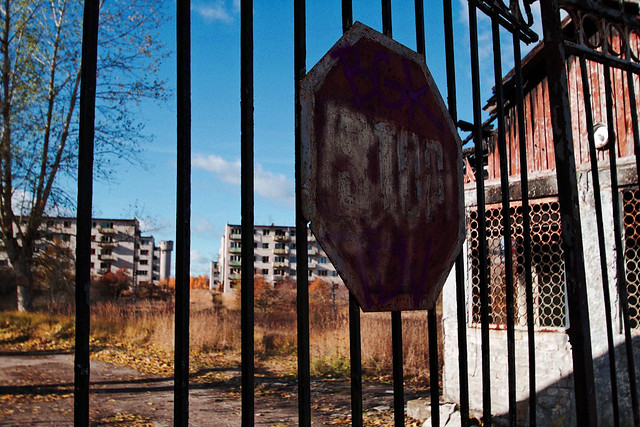
Skrunda 1

When the Soviet Union collapsed the Latvian’s held a dim view of Russian troops in their country, as you would as a newly independent people.

The Russians weren’t keen on leaving a major military RADAR station but history wasn’t interested and neither were the Latvians. Decades of oppression would test the best of us.

The Russian population in Skrunda drained away as fast as central Soviet rule. Not over night but in very large drips.

It was a standard Cold War town; watching for the missiles being sent to kill innocent communist children. It’s what they got told.

An absurd mirror faced by kids on both sides; both sides adding to their insane, world destroying armouries with gusto.

My generation grew up thinking the nuclear apocalypse was a distinct possibility. I now know, after visiting many Eastern Bloc countries, the same rumours circulated in Soviet schools and childhoods.

Whilst I was annoying my parents with music played too loud, my ‘iron curtain’ contemporaries were gathered around a record player listening to the same music; a smuggled, illegal print of a record pressed onto a used x-ray plate - ears pressed to the speaker, lest neighbours and then the police hear it. In the latter days the really ‘hip dudes’ had a cassette player to hide.

Skrunda was obsolete overnight. A disintegrating empire tries to protect the vital organs; the central power structure, the army, the police, then transport systems, the production and supply lines, on and on it goes right down to the minutiae of life. All designed and implemented to keep total control. It’s an ‘all or nothing’ game.

In retreat leave nothing of value or of any use. Skrunda’s School had a well appointed bathroom on each floor and every one had been smashed beyond necessary.

Far flung RADAR stations are an extravagance and quickly forgotten.


Skrunda Wild


Walking towards the town we used ready made animal trails through waist high grasses. Wild life is abundant in Latvia and wild boars have been known to wander the capital. Vicious swine’s they are too, when feeling threatened.

Latvia also has bears. Not enough to worry about. There are eleven of them. Yes, eleven. Latvian conservation websites are positive about this. It seems outlandishly precise as a number.

Eleven is not an estimate, surely? It’s a number. It makes it sound like they all have postal addresses and surnames.

Skrunda Mooch


The deserted town was alive with noise. Glass shattered unseen, always a street away. Doors in the distance slammed randomly in blocks of flats and unexplained, heavy thuds, added an edge.

Rushing gusts through paper yellow leaves sounded like static and became the background sound. The hissing swelled and subsided but never ceased.

Leaves cascaded over me as I stood underneath a shedding birch and turned to see the camera crew clicking like life may depend on it.

The town gym has a rotten floor. It has heroic Soviet murals on the walls; the athlete, the weightlifter, the marksman, the wrestler. Wind whipped in gusts through the building and the ceiling began to collapse behind us in places. Hearing the tearing and dropping of debris, we hot footed it out of the front entrance.
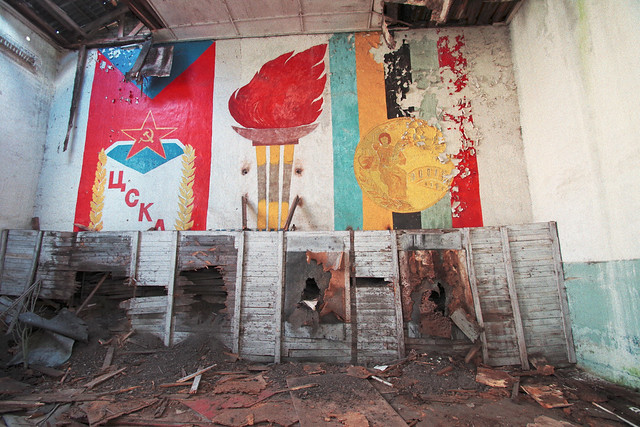
Skrunda 1, Latvia

Soviet Steps


Next was the school and the ‘Soviet steps’ test. We’d been told that the Soviets, in a daft rush to efficiency, had ergonomically angled each step on public building stairs here, so that they tipped you forward a little walking down them. This, so they said, made you walk more quickly to compensate for the tilt. Makes you move more quickly, get more done, so they said and claimed with a straight face.

So they said. What a bunch of joyless bean counters.

I thought this was all propaganda and a load of old bull. I was wrong. It is true. You can feel it when you walk up the stairwell in the school. Ascending takes a little more effort than it should. Descending them takes effort to not break into a trot.

Some funster thought that through. What a sinister little bastard.


School Guns


Each floor of the school had a large room at one end, fitted from floor to ceiling with school regulation gun racks. Like a cloakroom in a regular school but for guns, not coats. Like Military school. There was an instructional poster board, informing conscripts how to care for their boots.

All rooms had been completely stripped of any signs of a prior life. The whole town had been emptied to the last detail. They had even taken their litter. When they left, they were very thorough.


Don’t Panic
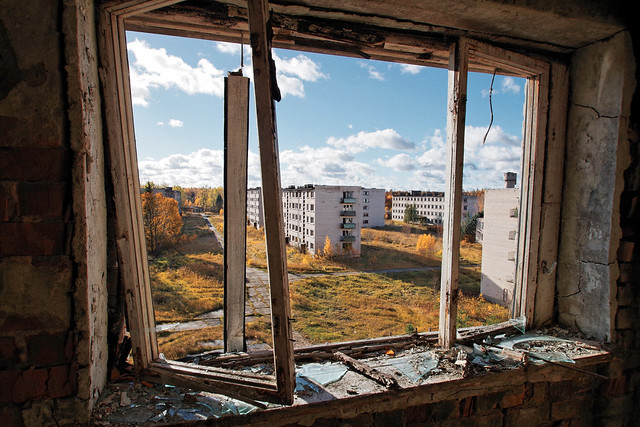

Skrunda 1, Latvia

Leaving the school I was stopped suddenly. Darmon grabbed my coat and motioned silence. We walked very quickly alongside blocks of flats.

“The police are here. They’ve blocked the entrance with a van and two of them are looking around.”

The wind rushed and subsided only to gust again. We dashed between buildings. As a group we walked down the town main street hiding in plain sight, keeping concerned eyes on street corners and high, broken windows.

Quietly entering another building we headed upwards, the better to see their van and possibly their route. We had no idea of their motivation, attitude or intentions.

Lying low in a theatre we saw the mosaic of Lenin; before tip toeing across the collapsed floor and around the wild boar shit in front of the stage.

The police got bored and left. After a sensible gap, we followed.
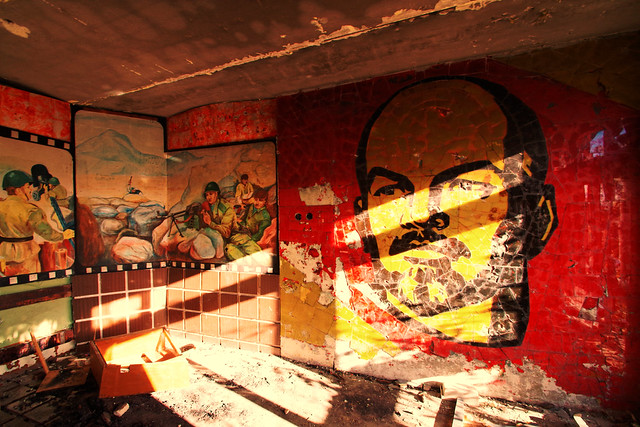
Skrunda 1


Skrunda to Kuldiga


It was a long drive and we made good time along straight, empty country roads, through a painter’s landscape. Flat farmland spread out on both sides, constantly backed by distant, thick forest.

Silver beech forests slowly revealed their winter skeletons, gust by gust; the evergreen fir’s pined, hidden within the ranks. Winter threatened the edges of the landscape, hesitating, not quite ready to invade.

Roads were mostly sealed and a dream to drive; long and straight through low, harvest bare farm fields and spectacular autumn forests. It was the advert for autumn that no computer could recreate. High definition, immersive TV has a long, long way to go.
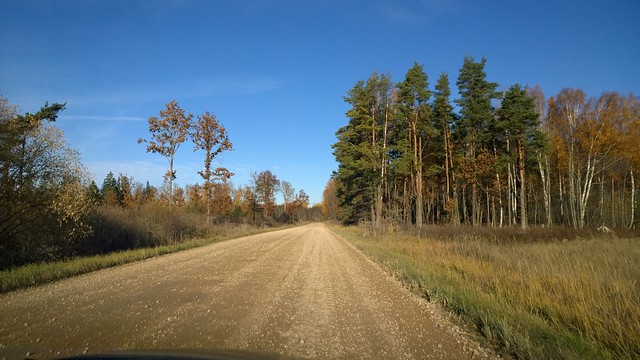
Untitled

The vast forest encroached in places, up to the road. An enormous, golden brown eagle lifted slowly from telephone lines on impressive, slow spanned wings, clearly scoping the area on invisible updrafts from the fields.

On the left, a large flock of small, dark birds reacted, taking off in an astonishing, synchronised flock launch. They twisted and turned on a sixpence and, like a school of aerial fish, arced over us then abruptly darted down into the low lying black fields.

We exited an arch of trees whilst they shed an autumnal palette of confetti tumbling through myriad shafts of golden filtered sunlight across our windscreen.

Above, our Baltic skies were blue wash, with the lightest frosting of unblemished white cloud.


Rural Latvia


On a long stretch through no signs of habitation, we saw a very old woman dropped off by the local bus on a road to nowhere, miles from anywhere. She wobbled off, bent over with shopping and determination. I can only imagine that she lives underground. There were no built destinations, nothing man made for many flat miles. Where was she going? We’ll never know.

At the desolate bus stop a guy in a t-shirt, in Baltic October, waited with his chainsaw hanging from one hand. Angry Ivan stood immobile as the bus pulled away. He didn’t even look up. He must’ve been waiting for the next bus, angrily, with his chainsaw.

Occasionally, the road was unsealed; a packed hard clay, a billion small stones and the unavoidable fist sized rocks. Four feet deep drainage ditches lined both sides, for ploughed snow and the inevitable thaw next year.

We barrelled through the landscape consulting sat nav directions and camera shutters whizzed and clicked.

Mid forest, without warning, the smooth tarmac ceased and the car wheels caught nothing but air before crashing with a bounce or two onto a section of the aforementioned clay track, a foot lower. The car fish- tailed tightly on landing.

Northern English exclamations were sworn as Frag, gurning in effort, held his nerve and steadied the ship, righting us back into a straight line through the forest.

Evening Stroll


Kuldiga is a mediaeval town. It has an ancient church, ramshackle wooden buildings, tiny town squares and a river running through it. It’s a quiet, quaint, interesting town as the sun goes down, in a Hammer House of Horror manner. You know the clichés.

We decided to stroll around the local area in search of food and beer. Frag and Tbolt pottered down the cobbles in front of me. The streets were deserted. Corners of winding lanes began to harbour shadows.

Lagging behind I saw a two story wooden house, with a balcony framed into a perfect picture between main street buildings. It looked like the Middle Ages and needed remembering.

I veered off to the left to have a nosey, proper look. The timber frames bowed heavily at the windows looking like they might burst and the eaves overhung the street. They were of a greying black wood only created by great age. Around the front I found a drab, modern cul-de-sac square. A very odd juxtaposition but proof it is a working, living town, not a heritage museum frozen in time.

A beautiful town with parks, ponds and statues, an old brick bridge led over the inevitable babbling brook. The architecture was pre-Soviet meddling, lending an individual atmosphere for a Latvian town. It was ornate and had tradition and a respectable air to it. No concrete or straight lines and strict right angles. No function over form - a peaceful, old place settling down for a mild autumn night.


Follow the Light


Turning back, I retraced my steps to find I had no idea where I was. Twilight became night and street lights began to illuminate wonky, muddled lanes and prim squares.

Early days, no panic, no problem, walk on.

One of us had to get lost to give the village’s axe wielding lunatic a chance. Since I had no inkling as to where I was or where to go, I volunteered to be victim number one. I thought that the town was so small that by continuous walking I’d recognise something, denizens would take pity on this idiot and all would be well.

Not a bit of it.

I enjoyed the feeling of being lost, at first. I wandered unconcerned, past ornate stone civic buildings and small windowed housing, the second floors with comfortable lamp light casting out over the narrow streets.

I passed local children playing; they stopped their chatter and games and stared at me, wandering and lost and stupid.

After an hour, I met a Latvian dumpling shaped woman walking in the opposite direction in a dark, cobbled alley way. I was utterly lost. She stopped and stood rigid, eyes wide in obvious fright of me. I smiled and attempted to continue but she was eyes-wide scared, frozen to the spot and looked like she may begin screaming.

Then I would be in real trouble. It would look so bad, I could see that. I’d done nothing wrong but that all felt irrelevant under the circumstances.

She was frightened to the point of soiling herself and could come out with anything when questioned. Innocence and guilt may well be amorphous concepts in rural Latvia, depending on the town, the time, the situation and none of this was on a stranger’s side. Explaining being lost in a strong Northern English accent would help in no way. Nobody speaks English in rural Latvia anyway. Why would they?

A Latvian gaol cell flashed through my mind. A night with the local axe wielding lunatic, it could be bus stop Ivan, the cell mate who likes chainsaws and cuddles. Oh, Dear Lord, may I disappear into the ground - or get away quickly around the corner and don’t stop walking, head down, for quite some time.

I backed away with my hands up, “I mean no harm. No harm. No problem. No problem.”

She was shaking as if she may lose it at any second. Oh God, what have I stumbled into?

As I backed around the corner I realised that ‘lost’ was not a good idea in Kuldiga and may be very unsafe if the town’s people turned out with pitch forks and burning, wooden torches.

I’d spread enough alarm by trying to find my way, in roads and streets and alleys all melding into one maddening circuit of confusion. I’d had enough. It was raining and I wanted shelter with food and beer.

In sheer wild card desperation I texted the chaps,

“I am completely lost, any ideas?”

Tbolt, the practical engineer, had a suggestion in reply to my SOS.

“Look for the police radio mast, red light on top.”

He was right. The police radio mast was a good hundred feet taller than the highest building in town. I found open ground to see the high mast.

Red light on top, it beckoned me to safety, only half an hour’s walk away, through a maze.

Welcome to Lithuania


Latvia and Lithuania have no discernable border between them. The only clue we’d crossed was a phone company text, reminding us what century we were really in.
Hamlets in the middle distance announced Lithuania with their idiosyncratic twin church spires. The farmland margins had wooden, World War Two watch towers.

The Hill of Crosses


Nearby towns are tiny, dice throws of houses in the three horizontal bands - blameless blue sky, distant dark forest and black furrowed fields.

The hill doesn’t look much from the road.

It looks inconsequential, more of a bump in the vast, flat landscape than a world famous pilgrimage site. We arrived shortly before sundown. A fat, blinding, orange sun hung heavy over the fields behind us.

The cameras began to prepare for a snapping frenzy. I walked straight to the top of the hill.

The history of the place is long. Nobody knows how it all really started. Rebellions occurred throughout mediaeval tumults. In the 1800’s the local population repeatedly rebelled against Tsarist rule.

Massacres ended the rebellions. Lacking bodies to bury after the hacking was done the locals placed crosses on what was a hill fort in day’s past. This tradition caught on and was added to during the Second World War. It became a symbol of defiance against all oppression.

When Soviet rule arrived they took a dim view of religious expression and banned it. They bulldozed the hill flat. The hill was rebuilt by night and the crosses replaced. They destroyed it again and it reappeared. This was repeated in a cycle throughout the Soviet years. When times passed and Soviet rule subsided, the hill became a pilgrimage destination for the Catholic faith.

The crosses began to be added daily in vast numbers. Some are no bigger than your thumb. Others would tower over your house. Statues of Mary and huge carved Jesus on The Cross stand sentinel at the end of a long, paved path. It is a remarkable place, a testament to hope and defiance.

Even this atheist could see that.
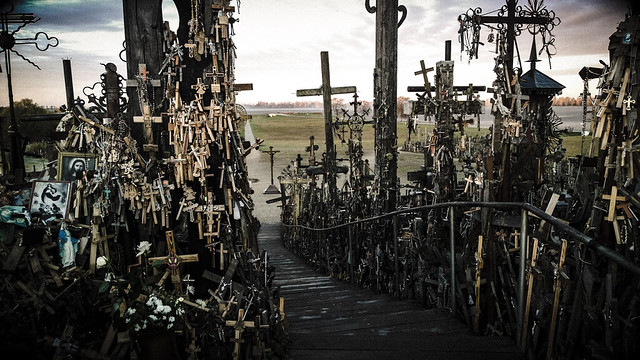
Hill of Crosses, Lithuania

The photo’s and films on the internet do not prepare you for the spectacle. An estimated 250, 000 crosses crammed onto a small hill of remembrance. Everyday, hopeful pilgrims hammer more crosses into the hill; satisfying their beliefs and the trinket sellers hawking tat in the distant car park.

I walked up through close passages between the crosses and the sun went down. An enormous full moon rose quickly to pose over the scene. The photographers tried to suppress a joint squeal at the perfect timing - a gothic photo heaven, to order.

The countless crosses and effigies, backed by a glorious harvest moon, were a memorable sight. I walked through slim passageways through the conglomeration and absorbed the atmosphere.

The last thing it is, is spooky. It exuded a calm, reverential air. It’s a very strange place indeed. I liked it. It seemed a good thing. I liked the idea of the rebellions it storied and the hope and calm defiance in the face of adversity it demonstrated.
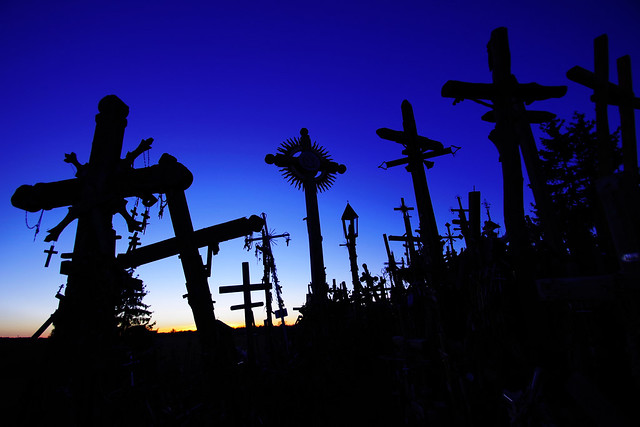
Hill of Crosses, Lithuania

Lithuanian Last Orders


Back at the hotel they closed the bar at 9.10 pm. There were only a sprinkling of customers and we were four of them. We were quiet, civilised and spending at the bar.

We retired sulking, feeling our hosts had underestimated how thirsty a quartet of Englishmen can be. No self respecting bar would close whilst there were punters with money and manners.

How many great anecdotes begin, “We were the only people in the bar and…”

Bloody load’s of them. That’s how many.

Dvina Nuclear Silo 


We drove through the landscape and followed the fighting sat navs. The long, straight empty roads made it easy. Ignoring the signs for the town of Plunge (the concept was worrying) we concentrated on tracks through the forest on either side of the road. Wherever we were going was not obvious or well travelled.

With Tbolt at the wheel we turned onto a mud track. The rutted track wound through the forest for miles and he pressed on.

Occasionally the forest revealed a steep roofed house, hidden from the world. They must live a strange, sylvan existence, lonely and isolated.

Tbolt was not a happy driver through the forest but he pushed on regardless. Whilst doing a sterling job under the circumstances, he had a salient point to make.

“Is this the right way? If it’s not, let’s face it, we have no idea where we are or where we are going. We can’t turn around, the wheels are stuck following ruts. I’m just guiding and steadying. We are snookered if this isn’t right.”

A good point well made and drowned out by giddy chaps refusing to take the prospect seriously.

“It’ll be reet, keep pedalling!” was not helpful.

Tbolt, as doubtful as he was, skilfully delivered us to a nuclear missile silo in the middle of the deepest, darkest forest in Lithuania.

Form over Function Mystery


Spilling out of the car, we needed to drop off this morning’s coffee. In a clearing in the deep dark forest was a visitor centre. It looked like a featureless iron brick with a glass door to enter.

Outside, we spied the W.C. sign and I followed. It led to another identical sign pointing down the side of the building. I followed and found no toilets, just the smooth iron wall of the building.

The iron wall at the back was stained with many fetid arcs of dried piss; relief of the masses after a long, uncertain drive. I had waited long enough and needed to add to the collage. You can take the boy out of Bolton but you can’t take Bolton out of the boy. It was odd but so was everything else.

Secret Silos
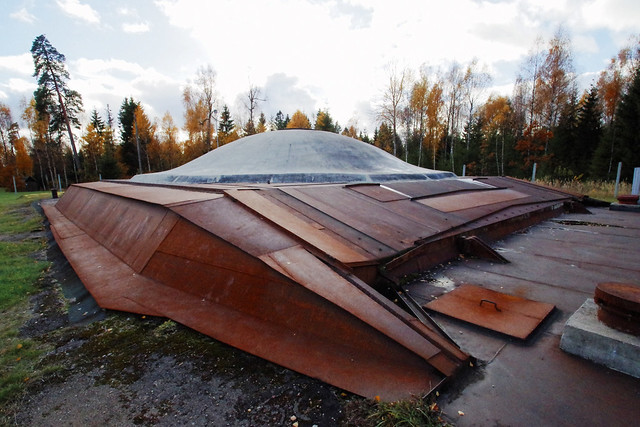

The missile silos are fantastically isolated in the vast forests of Lithuania. The Soviets built them in top Cold War secrecy mode in the 1960’s.

Dvina Nuclear Missile Silo, Lithuania

Very small teams of soldiers were taken into the forest by night. They dug it all out with spades because machinery would attract too much attention, even out here. Each team had no inkling as to what they were digging and constructing.

A warren of control rooms were built underground, to control and guard the facility. A real Cold War weapon of a site, built to defend them and destroy their enemies.

Depending on which side of the mirror you stood.

It was on a ‘need to know’ basis and the inner circle was tiny. The USSR hid this one, completely, for years. The silos were built to house and launch new, mid range nuclear missiles. Designed to destroy cities and vapourise the citizens of Western Europe, the missile was top secret and the location never to be discovered without satellites.

It is surrounded by security fences impossible to penetrate without detection. Movement sensors, barbed wire, razor wire, electric fences, all constructed in a web of circles, guarded 24 hours a day by soldiers ordered to shoot on sight. The surrounding forest is seemingly endless.

As a guard it must’ve been relatively easy in the summer. In the dark months of winter, at minus 20, in knee deep snow, a slicing wind and wolves howling in the forest, it must have been the worst posting a conscript could imagine.

It remained unknown until the US photographed it; found by the finest spy satellite technology the 1970’s had to offer in a very different age.

Weapons of Mass Disappointment


Descending two stories into the silo we walked around low, grey corridors with submarine-like sealing doors between each section. It was not a big place.

I was picturing Bond villain expansive underground headquarters; all piranha pools, henchmen (and henchwomen) ferried around in golf carts, shark tanks to throw enemies into, lasers to slice off bits of British spy and a high tech map of targets on a giant screen. A giant, self important leather chair would swivel, revealing a face scarred villain lounging and plotting the world’s destruction, in a vaguely Eastern European accent.

The truth was that it was claustrophobic and grey and dull. Frag launched his own gas attack as we made our way through the gun barrels of our once potent nemesis. The only potent parts now were Frag’s dreadful emissions. Unfortunately all gas masks were now displays.

Break glass in emergency, I read that somewhere.

Conscript postings here must have been very tedious. In an empty room, they were ‘Waiting for Godot’ and he never arrived, hence you’re reading this.

Both sides of the mirror spent uncountable sums on espionage. Frag proved his ability to empty a nuclear missile launch site, armed only with a dodgy supper leaking from him. It was touch and go for a while but Tbolt, Darmon and I survived.

The Cable Guys


The cable guys, as I shall call them, had one of the most important jobs in the USSR. They were waiting for the signal – a first strike or retaliation. They were ready and waiting. Either way the missiles would have been launched and I would not be writing or you reading.

As aforementioned the base was the top end of secrecy. Extreme paranoia seeped through the whole operation. This was the new secret weapon and nobody could know that it was festering here in the forest. Secrecy was the word.

The solution was a reminder of the world before computers, mobile phones and the internet.

They had a cluster of wires shrink wrapped into black plastic pipes to make wrist thick cable with a round plug on the end. It was the original cable. A foot away an identical cable lay with a round plug socket on the end. This was the secret communication wire direct from the Kremlin, there to play out doomsday.

They couldn’t keep the two cables permanently connected. They were concerned that this would lead to detection. It was based on the phone system which was easily spied on. Hence the plug and sockets end, in this grim room.

They had a regular phone on the table just above the cable ends. In an emergency, the Kremlin would call it and tell them to plug in THE SECRET CABLE FOR THE SECRET MESSAGE.

Then they would send the order to Nuke The Bastards!

Russia’s most secret order had to be phoned ahead on old phone lines, so that they could plug the secret cable together, to send the secret message they announced they were about to send. Brilliant. You’ve have to love the shambles of it.

Dvina Nuclear Missile Silo, Lithuania

Form Over Function Mystery Solved


Walking back towards the visitor centre we saw a family with young children arriving. Mum began to follow the WC signs. We hung around to see how the search would end.

She followed the signs and disappeared around the side, we all looked askance at each other. This won’t end well, we agreed. She emerged a minute later, from the opposite end of the building, shrugging in puzzlement.

In a stroke of genius, she entered the visitor centre to enquire into the mystery. She emerged with a member of staff who purposefully went around the side of the building.

She put both hands against the side wall and a giant iron screen moved to one side, revealing his and hers toilet doors behind it.

Judging by the rancid arcs across the back of the building, it was an extensive, international group of chumps with full bladders and no common sense, I’d joined. I’ll not be joining hands in solidarity until each man washes his hands thoroughly in boiling bleach. Dirty boys.

Stalin Meets Jonny


Tbolt piloted us back down the forest track towards the Hotel Plinksiu.

Crazy name, crazy hotel.

It’s not there owing to demand, nobody ‘demands’ to go there. A brutal blot of architecture in the centre of nowhere doesn’t feature in many holiday plans.
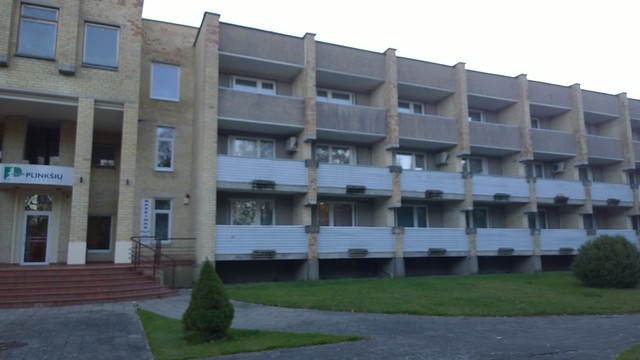
Untitled

The powers ‘that were’ decided the workers needed some fresh air and then manufactured a hotel to go to. In the middle of nowhere, with no amenities of any stripe within range without a helicopter, it is a Stalinist block at the end of a lost mud track.

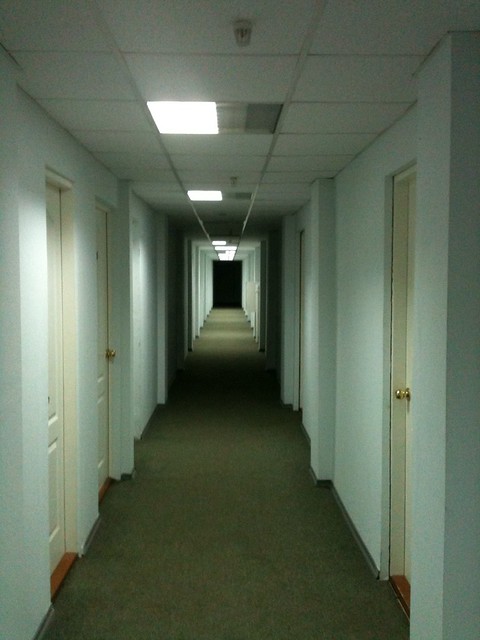
Inside it was a dead ringer for the hotel from the film, The Shining. All endless, half lit corridors lined with identical doors and mirrors. There were only us four and two Russian lads in the entire place. It was dead.

We were safe from the forest’s beasts in the dark hours. They were all frightened away by the fierce noise that Frag made all night.

A Ridiculous Breakfast


I arrived to bemused smiles from Tbolt and Darmon.

“Do you want the good news or the bad news first?”

“The good news is that the breakfast is okay.” said Darmon.
“The bad news is that none of it is for us.” chimed Tbolt.

The hotel receptionist had stopped them from eating the two breakfasts laid out, half way through eating. Now she was nervously apologising. They had been eating the Russian lads’ breakfast. Darmon carried on eating, regardless.

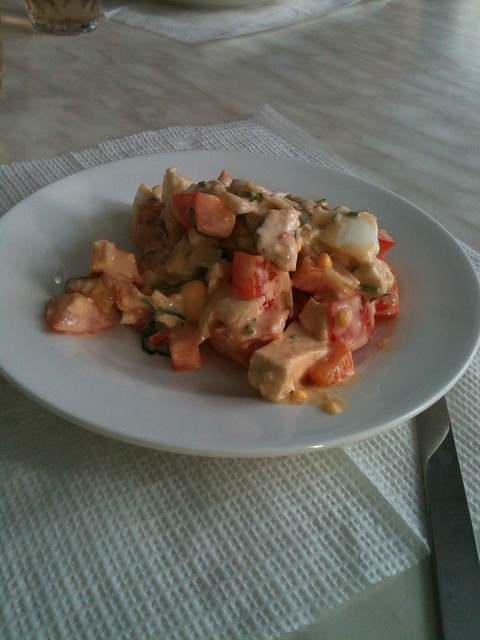
Tbolt asked, “It’s only egg salad. Can you not knock some more up?”

“Man in kitchen not here.”

I was incredulous and most put out. It was too much for me, first thing in the morning. They only had the six guests in two hundred rooms. The TV, lamp and shower in the room didn’t work properly or, in the case of the lamp, at all. They hadn’t made our breakfasts. They had allowed my colleagues to gnaw at the two they had made for the Russians, therefore ruining theirs too. I couldn’t contain myself at such mind blowing incompetence.

“This is bloody ridiculous!” I snapped at her. I then stomped off in a state of high dudgeon.

We weren’t finished yet. On checking out we tried to get coffee from the machine in the reception. There was no water in it.
“Can we have the coffee machine re-filled?”
“No. Not possible.”

Frag needed to buy cigarettes. A twenty pack was produced. Frag whipped out Ten Euros. There was not enough change in the building. He tried to buy all the cigarettes they had. The whole carton was produced. There was still nowhere near enough change.

As we started the car to leave, the two Russians, never the sunniest of chaps at the best of times, sulked heavily as they loaded luggage into the van next to us.

No potato for Sergey.

Sabile, Latvia


There was an old woman of Sabile,
Who stitched together gnomes a great deal,
When asked, “Why do you do it?”
She replied, “Oh Hell, screw it,
It’s either that or I’d die at the wheel!”*
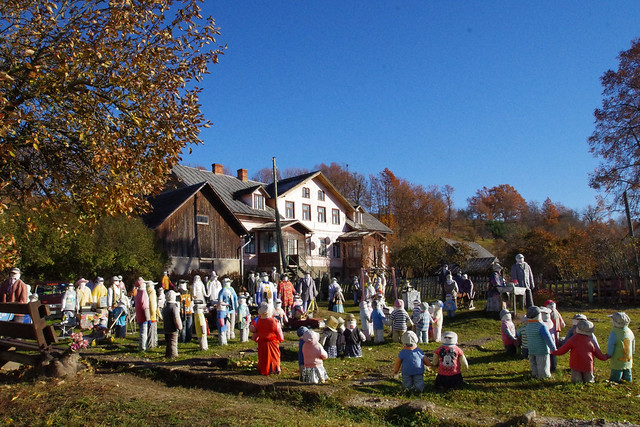
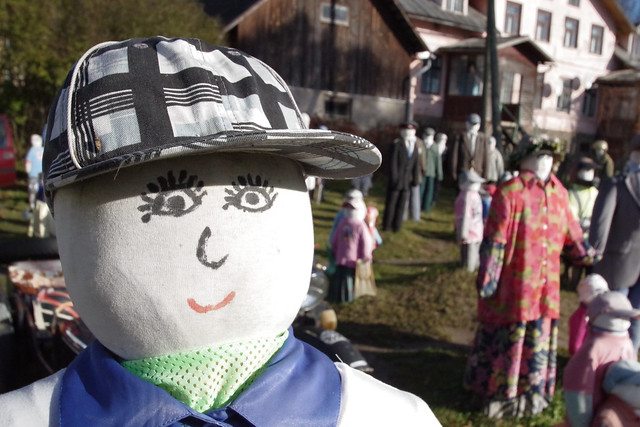
Doll Garden of Sabile, Latvia

Doll Garden of Sabile, Latvia

Salaspils Detour


Ending our jolly boy’s tour of Latvia and Lithuania we were in high spirits and ready for a grand night out as a crescendo. Darmon had insisted on a stop on the way into Riga. We passed a huge sculpture of a hand extending like tendons over the ring road around the city. It is there.

We indulged him and I am so glad that we did. I pulled into the car park in the forest, next to a gothic house surrounded by a grave yard.

As we made our way towards the memorial ground conversations ceased and we drifted away from each other towards our own experience.

Darmon was sure that we should visit the Nazi concentration camp memorial in Riga.

My mind jumped to a visit I’d made to Auschwitz, years earlier. The stain will never leave me.

Salaspils Concentration Camp


We fell into silence as we walked through the woods towards the expansive memorial. Not a word was spoken in all the time we were there. Not a word.

An enormous wedge of concrete announces the entrance. A carved list of numbers on the side could only mean one thing. I couldn’t read the script but the numbers carved there told their own story. They all had six figures.

The memorial ground is the camp grounds. It is a vast clearing amongst the trees. A bass heavy heart beat pounded, low, insistent, inescapable. Birds screamed their calls from the forest surrounding; the heart beat following wherever I wandered. You can feel it as much as hear it.

Sky high sculpted figures bunched together, dwarfing us and guarding over the tainted ground. Giants that remain now the evil is dissipated.

It was peaceful, until the silence was broken by a guard dog snarling and barking in the distance. Then, the sound of a clattering train, it was always a train. The sun of the day started to fail. The waves of misery and horror are still there, in that clearing. It was like drowning in sorrow.
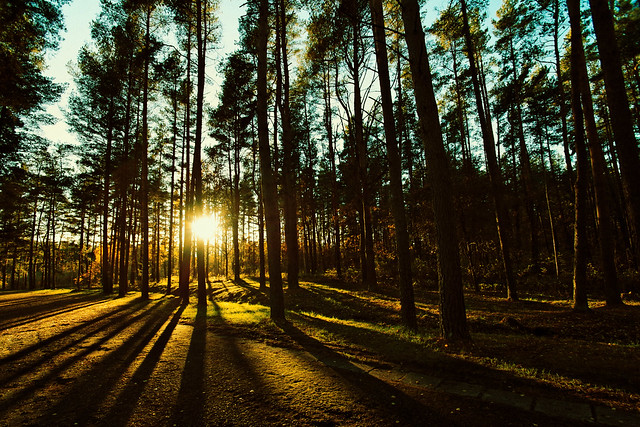
Salaspils Concentration Camp

I left. I’d had enough. The chaps walked with heads down back to the car, only a minute behind me. We were all in shock. We didn’t exchange a word. What an awful, beautiful place.

Riga 2


Stunned, we drove back into Riga to find the final hotel.

As we hit unforgiving rush hour with trams, trucks, taxis, commuter cars and no room for hesitation or idea as to right of way, we began to bicker. The conflicting advice firing across the car infuriated me.

“Go left, right! Not now, back there!”
“It was left onto the ring road.”
“Right, into that side road, not now, next one. No, hang on, take the next left.”

Buses undertook, vans overtook and trams threatened to slice the car in half from both sides.

Everyone had the right idea and no idea all at the same time, as to the lane to be in, U turn to throw, turn off to ignore and then the next one to be taken. They were worse than Corey the surfer sat nav that began the trip.

“Stop it! Stop it all!”

I was being over loaded by directions and worse still, opinions. They are not helpful in moving traffic on ‘the wrong side of the road’ at rush hour on an unknown road system.

I made a stand. “You tell me one list of directions, in order, and I’ll keep you and the car safe.” I may have raised my voice, slightly.

Our fractious group settled. We began to work for each other again. Frag gave directions ahead; Tbolt was rear view and side threat watchman.

“Turn left, next slip road, it’s a 40, drift lanes to the left on exit, towards the traffic lights.”

“Clear behind now, move left one, stay in lane, tram coming through. Clear now, nothing coming.”

We were good. The directions were bang on, now. I was able to negotiate the rush hour madness, able to concentrate and negotiate a definite route. I didn’t get us killed in a car accident. Success!

Pulling up in the hotel car park, I threw the keys at Frag and he handed them to Tbolt. It was time to quit.

Mick Smith
02.01.16


*I know you don’t pronounce the town name Sabile to rhyme with deal and wheel but it scans, so there it is. Any arguments and you can make your own bloody limerick up.


Wednesday, 19 August 2015

Tin Dog's Budapest Travelogue - October 2014

Every now and then, I drag poor Tin Dog and any other fools I can find to foreign lands such as Chernobyl for a bit of "Boys Own" and an explore, this one was all a bit last minute.

Well, over again to the ever wordy guest writer Tin Dog....

BUDAPEST
2014

Via Brussels

The journey is half the trip, so they say. They have never had to endure Brussels airport. A connecting flight is just in the way of a destination. Brussels airport is an airy warehouse, populated by display model citizens. It should be twinned with any corporate mall anywhere and includes the identikit orifices (offices?) that have spattered every city in the world. Brussels’ airport was horrific, in an IKEA manner.

There are endless escalators with directions to hither and thither in Flemish - it’s designed just for fun.

Not yours or mine, of course.

Airport Entertainment

At the tail end of the waiting hordes a pilot and his crew sashayed their way past us, gate bound and expecting speedy boarding and access all areas.

The windows of the passport control booths were only twenty metres away when they saw the whites of the pilot’s eyes. A border guard somehow raised himself above a custom’s desk booth to look down from on high, casting his petulant eye over the unwashed mob from a raised vantage.

Shouts and demands were made from both sides, in languages unfathomable. It soon descended into the language of swearing and threats, English. The stand off was revealed.

The self aggrandising flight captain of Michelle De Souris Airways had made a vainglorious entrance, to jump the enormous passport control queue.

A small man in black slacks, white shirt with packet creases and a giant, gold braided, peaked captain’s hat had demanded preferential treatment. We could all tell that he was frightfully important because of his fabulously giant hat and the phalanx of cheaply glamorous flight crew. Undaunted, our border guard proceeded to calmly and firmly stand his ground.

“You all have to queue.” stated our new hero, with the emphasis on all.

“We are crew and have dispensation.” The Captain made his stand. He was indignant and assertive, like a child denied his toy.

“You have no special dispensation if you are not piloting a flight. You are passengers.”

“We are flight crew and demand our right to board.”

“It’s not your flight. You are passengers. You must join the queue.”

This went on for a while. I’ve never enjoyed bureaucratic tennis so much in my life.

The Brussels’ border man would have none of it. The banana republic captain was outraged. In front of an already disgruntled audience this was a fine diversion. The Brussels’ border held firm and Captain Big Hat was held back and embarrassed in front of his overly fragrant entourage.

They wiggled on arrival and turned on him as they stomped away, to the outer reaches of the airport where the queue was rumoured, by this time, to be at.

He slunk away, his wheeled suitcase between his legs. The pouting crew stamped in high dudgeon after him – the babbling of complaints by humiliated women grew louder as they moved away. They were so annoyed that they were not obeying the laws of physics.

Hundreds of us cattle in transit cheered and applauded, quietly, internally, in silence. Standards must e’er be maintained. We still had our dignity after all, for now.


Szimpla, Budapest

After checking into our digs opposite The Tesla Museum in the Jewish quarter, we needed a night out. Tesla was closed for renovation but the bars weren’t. Aimlessly wandering the labyrinthine streets, past shuttered shops and seedy bars with huge, intimidating door staff, we happened on a place Frag had read about back in Blighty.

Szimpla ruin pub.

Szimpla Kert ruin bar, Budapest

The ‘ruin pub’ is a peculiarly Hungarian idea and all the more brilliant for it. Budapest is stacked with huge, magnificent, ornate buildings so majestic that only an empire could have built them. The city at its height must have been spectacular; full of boulevards and leafy squares, no corner is without an enormous bronze statue of a composer, king or warrior - Hungary’s heroes.

Recent times are not so grand and many of these fantastic buildings are elegantly wasting away and unused. Enterprising and imaginative entrepreneurs have decked out the interiors with art collective decorations; bars, bands, films, food and DJ’s, all laid on to entertain and turn a coin.

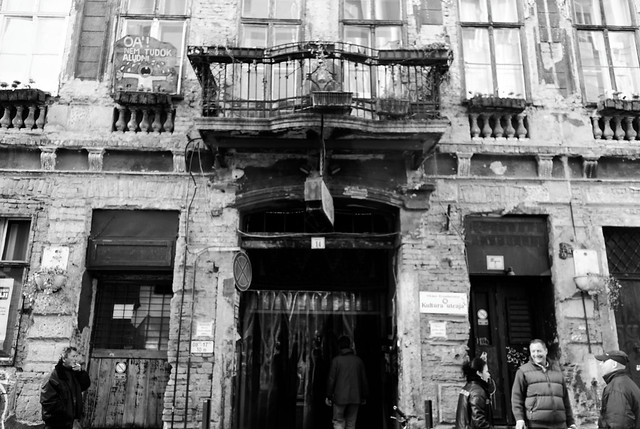
Szimpla is the first, biggest and best of these ruin pubs. Situated in a seedy side street, it occupies the middle of a large tenement building. The door is a gaping hole in brick, leading to heavy, plastic meat curtains found in factories and warehouses. Everything is cracked, crumbling and graffiti covered. The walls are slashed with leprous scars.  If you can keep your nerve and enter, you have done yourself a favour.

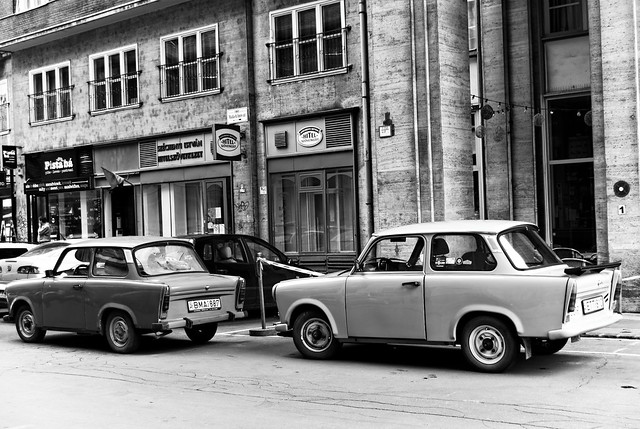
Once inside, we were confronted by a twisted wonderland. A long bar selling every kind of ruin on one side faced a decrepit staircase leading to more bars on the second floor. The front of the building is roofed, the back is not. A screen the size of a removal’s van showed black and white Soviet era information films. Punters sat in an old roofless Trabant, smoking, opposite a hookah bar. A room walled in flat screens shuddered and swirled like a kaleidoscope in time to the music. Posters for gigs long gone papered the walls and sculptures hung in between. Neon tube lighting snaked through the collaged walls. It looked like all the skips in Budapest had been emptied and the contents given to second year art students. The atmosphere was surprisingly unthreatening. We found a table and kept the drinks flowing, whilst shouting over the ninja tunes music. The rest is quite blurry. The crowd swayed and frooged and generally got down with their bad selves. Settling in, we had a night as big as the monuments in Independence square.


Sunday

The morning after the night before. It’s never clever is it? Never again until the next time, or Tuesday, as we became forced to call it. To say we’d gone for it is an understatement. At home I would have made it no further than my kitchen the day after a night like that. I wasn’t at home, I was in eastern Europe with Frag. He is intrepid and nothing can stop him.

Put your boots on and walk.

We wandered the empty Sunday city seeing the sights and felt ill. After eating in a Lebanese café for no other reason than it was called Titiz, we made for Andrassy Avenue. More of a boulevard than an avenue, it is the grandest street in the city. It’s broad enough to march a glorious, imperial army down, should you feel the urge.

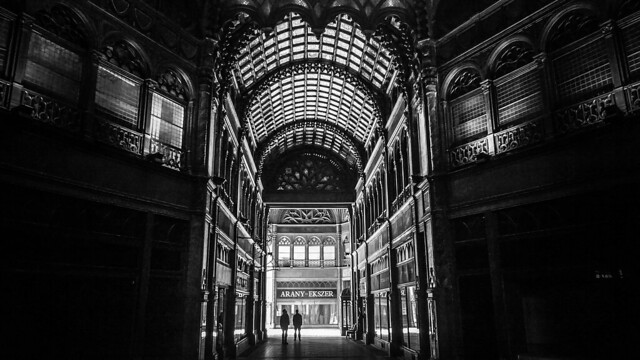
Parisi Udvar, Budapest

Café’s straight out of Tinker, Tailor, Soldier, Spy have polished, dark wainscoting and leather sofas with cake stands and doilies - next to shops selling weapons banned in most Western European countries. Need a sword, a suit of armour, a throwing star, nunchuks, an enormous military knife, vintage Luger, crossbow, long bow, assault rifle, sniper sights, infra-red night goggles, garrotte with moulded, plastic handles? Now you know where to go.

You bloody lunatic.


We meandered our way up Andrassy towards the centre. Shops became grand houses with stone balconies behind large, black steel security gates. These are the foreign embassies, existing in a reduced, shabby grandeur. Eventually, we arrived at Independence Square.

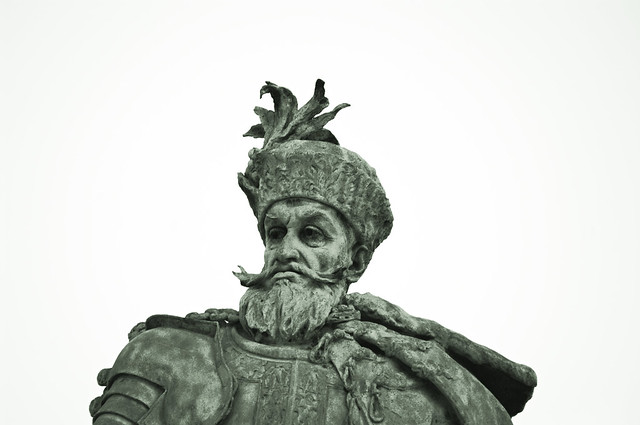
Like an exclamation mark at the end of Andrassy, it is expansive and grey stone paved. If you need to hold a sinister rally, this is the place. A gigantic empty square backed by an imposing semi-circle plinth of heroic proportions, raising up the kings and rulers of what is now Hungary. Giants in bronze, they brandish swords whilst mounted on rearing war steeds. Get a thesaurus and look up big and heroic. This place is all the words you’ll find there.

_IGP9671_DxO

A timetable of tour groups marched behind guides with ‘follow me’ umbrellas held aloft, lest they lose American’s Bud and Martha and they are lost and rendered homeless. Budapest doesn’t need any more homeless. Piles of sleeping rags with greasy fronds peeping out are not uncommon in the streets. The poor bastards that fell through the cracks in life occasionally attempt to beg. They are not very vigorous about it. They need lessons from a child in Marrakech.

This show city square backs onto a vast, ornate, open air spa. Packed with flesh in the summer it is drained and cleaned in the winter. It’s best that we were there in October, lest we would have had to endure the sight of Frag in his budgie smugglers.

The Horror, the horror.

_IGP9680_DxO

Royal Park Aristocracy

Behind the spa stands a fairy tale castle. Now a museum that does not open on a Sunday, it was never the less, hugely impressive. The largest windows I think I’ve ever seen allowed nobles and knaves to look out over their magnificent, wooded hunting park, stretching into the distance at the back. It has spires and turrets and arches and conical roofed towers for damsels in distress to toss their golden locks from. All it needed was a dragon. Instead it was guarded by a beautiful, elegant, old woman collecting for an animal charity. I slipped her a Forint note. She spoke English.

“Thank you.”

“You have a wonderful city here. It is majestic.”

“Oh, it used to be, when I was young. Now the only thing majestic is our politicians’ bank accounts.”

“Are they thieves?”

In cut glass English, “Yes…just look around. They don’t care. Our beauty is fading.”

She smiled a thin, frail smile and looked way off, over the grand park, towards high rise flats in the distance.

Her life and Budapest.

It was perfect melancholy to accompany the slanting autumn sunlight through the leafless trees reaching out into the royal park.

Goulash Revival

We made our way back towards the Jewish quarter, passed the monolithic synagogue, into the maze of streets behind. I still felt like dying. We really must have drunk the Danube dry last night. It was agreed that we needed food before giving up for the day.

A hundred yards from our digs was a café bar we’d already used. Run by two, young, hardworking local lads, it was just right for me, right then. I saw a sign promising goulash. This hit a sweet spot in my brain. I’ve not eaten goulash in years. I’m in Hungary. I needed a reviving tonic. An elixir. A panacea.

“I’m having goulash.” I announced to Frag.
“You dirty bastard.” He replied.

The boys could see we were in a bit of a state and welcomed us with knowing grins. Frag sat fingering a menu, all indecisive. I meant what I said and demanded goulash. It arrived in a small cauldron on a curved, iron stand. I beamed so wide I had a flip top head. It smelled like life itself and it tasted like heavenly faire. At that moment, at just the right time and by pure serendipity, I had struck gold. Each spoonful made me feel better. Not good, let’s face it we’d battered our aging systems, just many times better. I actually began to feel like I might not die, just yet.

Frag, witnessing the transformation and my mood lifting from cantankerous for the first time that day, became intrigued. Then he ordered the goulash. As we left for our digs we smiled for the first time since we rolled out of Szimpla the night before.

IMGP4236_DxO


The Blue Horse

We ordered local beer and sat down, the only customers. We were early.

After Saturday’s hi-jinks we were still a little subdued. Self admonishing, we swore we would be sensible from now on.

Sat at the bar, we chatted idly to the owner about the day’s news. An anti-government demonstration had been held in Budapest on Sunday night, drawing thousands. The owner’s husband, arriving fresh in from work, filled in the details.

The government were planning to tax the internet. Hungary would be the only country in the world to do this. Hungary and all its political parties, left and right united in opposition, had called for mass demonstrations.

We’d already seen ten thousand on our hotel TV sets, protesting through the streets, into squares and down towards the Danube’s bridges. It looked very impressive on the TV reports beamed all over the world. A repeat demonstration was planned every two days until the foolishness was dropped.

“The next demonstration will be bigger. It is in Josef Naider Square tomorrow at 6.30pm. There will be speeches…many people there.”

The man was insistent, eloquent and very persuasive, as was the Hungarian bitter honey beer. I’d never been to an anti-government demonstration in any country. How could we not attend?

No matter how old you are, you never remember to know better.


Demonstrate

A sharp evening, October chill seeped from the Danube as we made our way to Josef Naider Square. It was season change cold. The streets we’d wound through, easily exploring, now seemed threatening. People were making their way home from work; queuing for buses, waving at taxis and streaming away from the action on bicycles and the police started to appear, in numbers. Night fell, as if to order.

In the side streets off each thoroughfare, leading to the squares and main streets, police were beginning to glut and block exits and rat run routes. Mad Max armoured hordes of police with batons and thick, matt black guns began to gather. Staring through blank riot shields and visors, they looked more of a problem than a solution.

Black, armoured police vans with meshed windows waiting at every intersection helped the intimidation. There was an atmosphere brewing. Frag bought cigarettes from a government licensed tobacconist shop to calm us. I watched as people joined the crowd until I had never seen so many people in one place. In every direction the crowds made their way in from the surrounding main streets. It was remarkable.

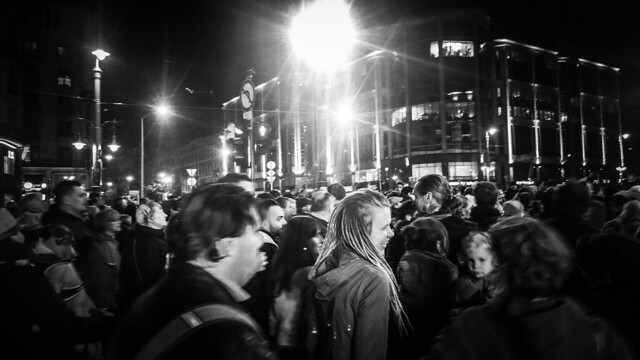
Arriving at Josef Naider Square to the sound of Pink Floyd’s Money shouting from a giant P.A., we wormed through the bubbling crowd. I’d expected a raggle taggle rent a mob but couldn’t have been more wrong. Okay, there was the odd anarchist flag and Guido Fawkes Anonymous mask, lightly punctuating the faces in the crowd but they were a tiny minority.

The ordinary people of Budapest had turned out, every man jack of ‘em; the young grinning and giggling in excitement, the old shuffling and puffing in the icy air, the middle aged remembering tightly controlled Soviet childhoods and young families with the future in push chairs.

The square was full, yet still they wriggled through the thickening block of humanity into any available space. Steam from Impromptu hot drink stalls rolled over the massing crowd, lit from above by the ornamental lights adorning the eaves of the imposing stone buildings hemming the square.

The speechifying began. We didn’t need to understand the language, the anger was clear. The crowd chanted and cheered each speaker. Frag and I cheered along. The entire mass held their phones aloft, we waved our phones too. Applause broke out and we clapped along.

Tens of thousands of Hungarians protested in Budapest against the government's plan to tax the Internet

The protest had been going for around half an hour when the crowd turned towards the back of the square and began to move as one. I thought trouble had broken out, supposing that thousands of armed police and tens of thousands of angry protesters were a volatile mix. I’d underestimated the civility of the people of Budapest. They were beginning a march around the city.

Not having the courage of their convictions, we realised it was bloody freezing and this makes an Englishman hungry and thirsty. We’d done our bit, now it was time for food and alcohol to thaw us out.

Threading against the crowd, we moved in the opposite direction towards our evening. Then we came to crossing the road. It was on the march route. It was so packed that moving crossways through them was not an option. We waited for the politely pissed off mass of humanity to pass. We waited and waited. We waited some more. Then we decided it was best to keep waiting. We began to realise how big this event was. They chanted slogans as they pushed on down the road and it seemed like there was no end to them.

I mentioned the civility of the people of Budapest for a reason. Later, in my hotel room, I put on the TV to see English language news. The protest swelled to one hundred thousand people and yet there was not a single arrest. Not one.

Forty eight hours after we departed Budapest the government backed down and scrapped their crazy plan. Frag and I like to think that we tipped the balance.

You are welcome, Hungary. No problem.

The Secret Number


Frag had been given a phone number back in Blighty. We amused ourselves with references to the secret number. I knew it would not be a gentle mono-rail to a gift shop and how we laughed.

Now, at a loose end in Budapest, we had the hotel reception phone the number for us and we waited for the taxi with no idea as to what we’d inadvertently started. No change there then. We sped out of the civilised city.

In the taxi, storied blocks of concrete flashed by; domino stacked, impersonal, anonymous, flecked with the occasional floral door marker, an attempt to personalise concrete conformity. Not a tourist Budapest - reality, away from the boulevards and coffee shops and bronze statues of heroes and composers and kings.

The taxi raced the rusty brown train line, with utility wiring strung loosely between concrete posts rushing parallel to us. Nobody spoke and I wondered where the bloody Hell we were being ferried to.  

Pulling up under a concrete overpass, the silent driver pointed to an anonymous white wooden door in the side of a low factory building. We paid the man and followed his directions. It was a very grim location. Through the grubby door was a grubby corridor that abruptly turned left into another grubby corridor. No windows, no signs, just follow. Finally, we were faced by a cheerful young woman sat behind glass like a bank teller.

“Good afternoon, gentlemen.”

She pushed laminated menus into the tray under the glass screen. We heard sharp, mechanical cracks and thuds from nearby. The menus were for an assortment of guns.

There was the beginner package, the gamer package, the I’ve seen too many films package, the hero in his own mind package, the you’ll get yours, you bastards package, the potentially going postal package, the I shouldn’t be allowed out ever again package and finally, the somebody stop me, I’m not safe package.

It was insane. Sheer madness. You could, for a nominal fee, hire an arsenal and fire live ammunition, with no training beyond a video lasting 90 seconds, in a low corridor of a room.

I don’t like guns. In everyday life in England they are never needed. I signed up for the ‘If you get killed, don’t blame us package’ and we were led to a square, wooden waiting room. A large coffee table contained back copies of some Hungarian gun nut magazine and a monster sized man introduced himself.

Laszlo must be one of the largest, most imposing human beings you could wish to not meet on a dark night in an alley or anywhere else. It was a big room and this man filled it, an eclipse of a chap. He was a good foot taller than is necessary, square of shoulder and jaw and efficiently amiable in a military manner.

I had the feeling of being tolerated by a man who could feed me to his children, on a whim. He was helpful like a farmer is to livestock. Shaking hands with this enormous individual, I asked him if he was ex-forces.

“Ex Hungarian Para-commando, ex Hungarian military police.”

Think of Arnold Schwarzenegger smiling and saying that and being slightly annoyed. Now you have the picture, let’s move on.

He was quite friendly and he frightened me to death. He bade us follow him to the firing range and we were not in a position to ask any questions.

I’d always, naively, imagined a gun range firing live ammunition to be out in the countryside. The shooting would take place across a field of knee length grass, towards the man shaped targets by the trees in the distance, just like the films.

We were led into a black room less than a hundred metres long, with a low ceiling. To the left, wall racked and stacked, was a library of weapons. Hand guns and rifles, shotguns and machine guns. Sniper rifles attached to stands hung from the wall. The other wall and the ceiling were covered in black silencing foam, like a recording studio. A woodwork bench of guns and spent shells divided the room at our end, which was itself divided in the middle by a framed, woodchip screen to separate the shooters.

Wood chip screen. I’m no gun expert but…

After the very brief safety video on a wall mounted TV, we were commanded, that is the correct term here, to step one by one to the bench. Laszlo, ever helpful and intimidating, loaded the weapons and handed them to me; the Magnum, the Glock, the sniper rifle, the AK 47, the machine gun, on it went, culminating with the pump action shotgun.

I enjoyed the shooting and was horrified at my accuracy and enjoyment. The recoil was sharp and sudden with the hand guns. The magnum barrel shoots back as it fires, hold it like this, or lose your thumbs. A pump action shot gun feels like it looks on the films - shockingly violent.

I was glad when it was over. I’m glad I did it but I don’t want another go. I have no need of these abominable machines.

Under the overpass outside, awaiting the taxi, we were eager to leave. “My heart is still pounding.” said a visibly shocked Frag. Not just me then.

Uneasy History

Half way along Andrassy, we saw The Torture Museum.

Fading Daguerreotypes, embedded ovals surround the building at head height, interspersed with tea light candles. A roll call of innocents snuffed out by successive regimes, Nazi and Communist. Hungary has had an appalling, gut wrenching history. From glorious empire to torture chamber, they’ve endured the extremes. Hungary had a Nazi party well before the Austrian lunatic ranted and spewed his bile in the beer halls of Munich.

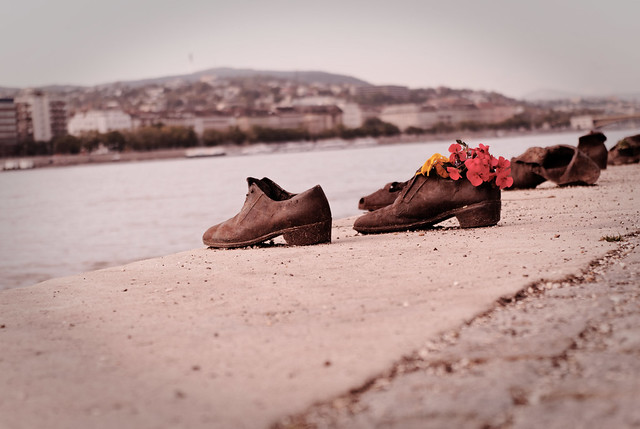
Hungary had the Nazis at their foulest and co-operated. Hundreds of crumpled boots and well-worn heels and babies first’s have been die-cast in iron. They line the river’s edge. The Jews of Budapest tossed into the Danube to die. They stand facing the river, reminding us of the capitulation of the population to fear and tyranny. Neighbours were now enemies. Desperate times lead to despicable acts. When that crime against humanity was over, Communism grew like a boil on their existence, enforced and embraced, by Moscow’s putrescent dictatorship and Hungary’s shattered populace. The State dictated every aspect of life, from the colour of your shirt to the music you could hear to the thoughts you could conjure and discuss.

The torture chambers under Andrassy are damp, squalid, brick boxes of misery.

Shoes on the Danube Bank, Budapest

Parliament Square Parade

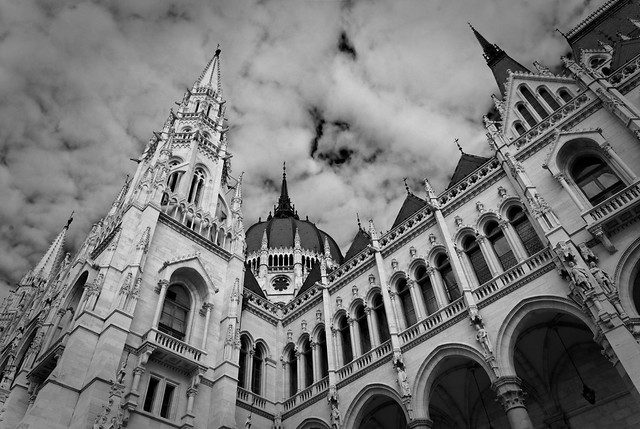
Arriving at the palatial parliament overlooking the Danube, we walked into the past poking the present. A contained contingent of soldiers in full fig marched across the square. Small in number, they marched across the storied square to raise The Flag. No crowds or ceremony attended, just tourists with camera phones and ipads.
Left sided by the pomp with no fanfare, I was almost mown down by marching soldiers.

It was Independence Day in Budapest. They were well drilled, well dressed and unstoppable. They nearly bowled over the aimless, gawping tourists that wandered through their mission path; including two chumps from England.
Only a country so invaded and sat on by two totalitarian regimes would take so much pride in independence and then ignore the commemoration; or possibly an unpopular government attempting a nationalist spin to tick boxes. Probably both.

Whilst Budapest appeared un-interested in the Memorial Day, I got the impression that the current right wing government had ordered the solemn display. There were no witnesses or crowds glorying in the past, save a spattering of tourists taking selfies in the awe inspiring square. It was an odd occurrence. They were commemorating a major event in Hungary’s history, yet nobody seemed interested. Only tourists attended, like us, by accident.

In 1956 the Soviet authorities had attempted to impose a new constitution on the puppet government. The public had naively massed to their parliament to protest. The Soviets in the Kremlin sent in the tanks. They shelled and tank gunned a crowd of unarmed civilians. Thousands were there, man, woman and child. The numbers murdered are disputed but tanks versus an unarmed populace could only end one way. The massacre in the square was huge and without conscience. The spark was the show of defiance in parliament square.  It’s generally agreed that 30,000 died off the back of this rebellion. Tanks finished off the wounded with their guns. Now, it appeared that no-one cared, or was too scared to turn out. It appeared to have been hi-jacked by a very unpopular, right wing government.

We descended incongruous steps in the middle of the square to find the official memorial. An L shaped basement told the story in a corporate museum manner, some original artefacts interspersed with inter-active screens and leaflets of explanation. Frag beckoned me towards one end of the L. There was a coffin covered in fresh flowers; either side stood a motionless soldier in full dress uniform, standing to severe attention with guns in a ceremonial, shoulder leaning fashion with funereal, martial music, haunting out of speakers by each side of the Unknown Soldier. It wasn’t just a memorial, it was a statement of the present government’s projected image.

The Hungarian Parliament Building, Budapest

Later, I asked the lads who produce the magic goulash about the display. They were both very proud of their heritage and traditions but had utter contempt for their government and its ‘theft of the past and our truth’. They were very angry at their government, just like the crowds in Josef Naider Square.

Budapest Street Art

It was time to leave or, considering what we’d seen, retreat. Back at our hotel we made to leave this exhausting stew of a city. Budapest to Brussels to Manchester. A connecting flight is just in the way of a destination.

Budapest, you are a majestic, fading beauty.

Tin Dog


Saturday, 27 April 2013

Tin Dog's Chernobyl March 2013 Travelogue


It's guest writer time, all words from the ever wordy Tin Dog, only the names have been changed to protect the innocent....

 Chernobyl 2013
 
As promised to nobody, here is the whole story of our trip to Ukraine. I travelled with two intrepid chaps, Urban Spaceman and Fragglehunter, both of whom are old enough to know better; taking in Kiev and the nuclear exclusion zone containing the Chernobyl reactors and the ‘ghost city’ Pripyat.


The Soviets lied when it happened, they've lied to us during the intervening years and Ukraine is still lying to the world now. However much they attempted to put a positive spin on the ongoing work, Chernobyl is a radioactive mess that will still be a problem in twenty thousand years. It will never go away.


Ukraine from above was very unusual. There was no landscape. I have flown over many countries and they all have hills, mountains, valleys, lakes, forests, cities, and land of varying hues. Not Ukraine. Ukraine is flat and white for hundreds of miles in all directions. White and flat forever. This is a country that is so flat that, with binoculars, you could watch your dog run away in the snow for three days - run Fido run!


Kiev airport was very modern except it had no shops, cafes or any other amenity. Staffed by Soviet era looking guards in olive green fatigues, guns and stares cold, Ukraine announced itself and it was glum.

We left the building to seek the smoking area. It was in a windy bus shelter at the end of the platform and therefore never needed sweeping. Nothing could stay or live there for long.


Our contact began like this;


We were met by a very square shaped man, in a black VW van...eventually. He was looking for us whilst being pursued by the police for a parking infringement in the airport. He could not park up to meet us for more than a minute before the Ukrainian boys in blue arrived. The police turned out to be very scary people and best not encountered. His reticence in pulling up for any length of time was understandable. 


We phoned our contact in Kiev who assured us our driver was in the airport looking for us. As we wandered a car park looking for said van, we heard shouty beckoning in Ukrainian from the square shaped man. He was across two busy car lanes outside the airport entrance, with the police crawling towards him - the police were staring at us three chumps. 

We ran through moving traffic with our luggage to get to our van before the police could arrest our man. Bags chucked in and doors slammed, we took off at high speed into a dual carriage way that led to Kiev proper. It wasn’t a car chase, more of a brooding, malevolent tail-gating. The police gave up or got bored as we left the airport perimeter.


Welcome to the gangster run kleptocracy that is the State of Ukraine (and just look at the bloody state of it). The news is State controlled and the police aren’t.


Our driver spoke not a word all the way to our digs, forty minutes away.

The language chasm took care of that. Incongruously, Lennon’s ‘Imagine’ seeped from the van’s speakers.


When we arrived at our digs in the city the fun began. We had insisted that we would be stopping together. Not in the same room of course, ahem, but in adjoining rooms.


Kiev Digs


We arrived at what can only be described as a hippy commune in an old Soviet block, in the centre of town. Then we were informed that there was 'no room at the inn' for two of us. We would be stopping at separate locations nearby. Kiev is a place that it's best to have the security of friends with you. Urban Spaceman and I were led off into the bitterly cold night to digs in different locations. Fraggle, being the man who started this whole crazy business, got first dibs. He consequently spent the night on a thin mattress on the floor of a box room office, with fairy lights flashing pretty colours on and off all night. How the Spaceman and I laughed when told the morning after, by a very pissed off Fraggle. 


The entrance to the place I stopped in was not inviting. Two grey, heavy plate steel security doors were entered by security code. The graffiti across them didn't add any stars for a web review. Inside was akin to a cross between a backpackers and Soviet utility, over-engineering.

The radiator in my room could’ve kick started the whole global warming thing, single-handedly. I was only doing two nights there, Thursday and the Saturday after Chernobyl and Pripyat. The digs were like being eighteen again but with all the fun bits removed. It was the least of my worries, considering where we were headed. We were all very thirsty by now. We needed drinks, food and plans.


Morning Meet


Miraculously, we managed without wives or alarms, to meet at the agreed place at seven forty-five...the morning after a large night out in a twenty four hour cellar bar; where vodka was as cheap as it should be and steak dinners cost wads of Ukraine money (£1.50). 


We met at a bus stop that none of us had ever seen beyond a street map. We were all competent idiots, there at the appointed hour. It was fiercely cold. I had kitted out with so many layers, be-scarved and topped with black woolly hat that yes, I did look like a fat, armed robber. We took a bus to the central train station, the tour meeting point.


Kiev train station inside is very ornate. This information does not help this tale in any way and is quite useless.


Kiev station at morning rush hour needs to be seen to be believed. It was severely cold. A brutal, biting wind swept the station entrance. Kebab stalls were selling morning kebabs which consisted of rancid, fatty meat on a roll as thick as an off-road car tyre. It was grey where it wasn’t a sceptic yellow. It would be safer eating car tyres. 


 Kiev Central Rail Station


The evil yellow M of McDonald's was doing a roaring trade. Obviously most of the profit goes to Mac's headquarters in the US. This being a kleptocracy, they had a way around this. They have built an identical building with identical coloured livery, just next door. It sells ersatz Mac' meals that undercut their rivals and it sells beer, at breakfast time. Its name in Mac’ style lettering and colouring, I kid you not, is McFoxy's. Meanwhile, ruddy-faced commuters rushed to mystery destinations in heavy overcoats and bubble coats and fur hats, whilst shouting into mobile 'phones. Beggars began to mither for money and moved on when stall holders harangued them. To English ears, Ukrainian sounds aggressive, like the beginning of a fight, especially when being shouted at the freezing beggars.


We met a man with a sign proclaiming, 'Chernobyl and Pripyat tour - see, feel, experience...but don't touch!' We had our man.


Another mini-van, another hundred kilometres, to the nuclear exclusion zone.


Exclusion Zone


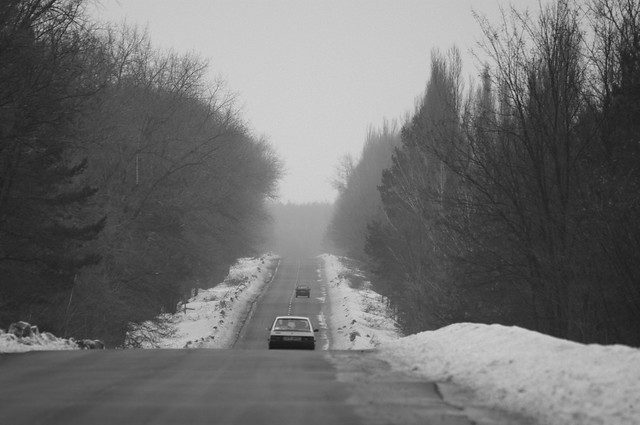
Once out of the city we were driven through the flat, featureless landscape. This was a two hour drive through the country glimpsed from the 'plane. The road to Chernobyl stretched out, miles straight, into the distance.


Stood in the centre of the road, looking down the dotted white line, it was framed into a funnel by bare trees on either side to the horizon.


Either side - frozen wastes of nothing.


 Chernobyl 2013


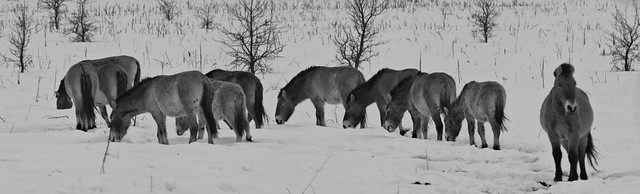
Occasionally, the road margin of trees fell away to reveal, within clear view, wild horses grazing in small herds. On the other side were machines - bulldozers, cranes, trucks and other heavy, rusting transport. We pulled over for a break and the introduction to our official guide.


Chernobyl's Przewalski's horses


A woman in her late twenties wrapped against the severity of a Ukraine winter, she was smiling and friendly and a little nervous. Our small group stood smoking and chatting. In one’s and two’s people peeled away to take the first of several million photo’s.


A huge wooden crucifix had been planted nearby; a traditional Ukrainian women's head-scarf, white with a blood red-rose pattern wrapped around it. We began to realise the gravity of the whole trip. I can't say I wasn't worried, I was. We all were. It was apparent that whatever we'd researched and prepared for, it would be lacking. We had to pass three checkpoints to reach our hotel nearly thirty miles away, a mile or so from the reactors. “Guys, you must not take photo of checkpoint or soldiers. You will be arrested. Please, take this very serious. It is not joke. It is dangerous. You must follow advice.” She spoke the English of that irritating meerkat on that bloody insurance ad, or a Bond love interest in the seventies movies. Your age will supply you with the necessary reference.

  
Checkpoint


The nuclear exclusion zone begins thirty miles from the reactor. We stopped at the first checkpoint and it all got very serious. You need official, government permission to enter the exclusion zone. It's not an easy place to walk into. The check point was all your Cold War nightmares come true. A brick hut next to the road, just big enough to drink coffee and regret your existence in. Expressionless soldiers stood in olive camouflage, in three foot deep snow...with shiny, black guns.   


I'd been signed up to this tour at the last minute, back in Blighty. Consequently, I was not with the 'S' names. I was at the end of the list that the bored guard had been issued with. At gun point, I showed him my passport. He stared me in the eye then looked down at the passport. He ran his finger down his list to the 'S' names. His interest perked up no end. He looked back up at me and I knew there was a problem because in a heavy accent he said, "There is problem." I was spluttering explanations when the other soldier pointed his gun at my chest. I raised my arms in a pathetic 'I'm not armed and I come in peace' show of fear.


All my border guard experiences were concentrated into that one moment. Gun pointer's friends stepped forward to surround me and back him up. I insisted that I was on 'the list'.

‘On the list’ sounds very bad if you consider your history lessons.


“I will put you on ze list! Vat iss your name?”

“Don’t tell him, Pike!”


‘On the list’ is never where you want to be at nuclear exclusion zone checkpoints, until now. I was motor mouthing to justify my presence there when Urban Spaceman sussed the problem. "He's at the end of the list, not in the 'S' names." Translations were made and they dropped their guns. I farted quietly, by way of appreciation.


The twenty mile border check was the same but much less interesting. It was fart free. Climb out of the mini-bus and produce your documents. Passports and checklists, no problem. No soldiers threatened to shoot me. Result.


The ten mile check point was stringent and excitement free. Just pointed guns and passports, again. We were told that inside this ten mile zone the rules were very strictly enforced. The rules can be distilled into one phrase, ‘do as you are told’. 


One of the rules was no alcohol inside the ten mile zone. The groan of disapproval and desperation in the bus was very loud. “Shit! We should have stocked up in Kiev.” was exclaimed in a minimum of five languages. Then we drove straight to the hotel sulking in those languages. We were unaware that the drinking ban, unlike other rules, was not strictly enforced. Then again, we were unaware of a lot of things.


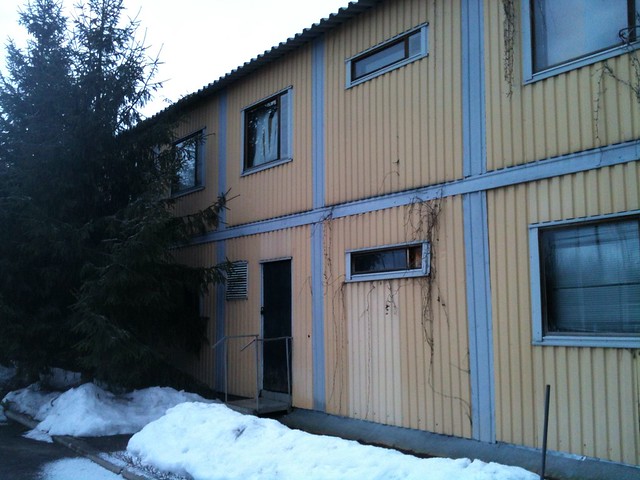
Chernobyl Hotel


The two star hotel consisted of a two hundred yard long corrugated iron hut with car park for twenty cars, ringed by a linked wire fence. It looked like a down beat industrial estate. It was surrounded by identikit concrete flats on one side, emptiness on the other.

The two stars were won on the grounds that it had two floors and a roof and, if you don’t leave the building at night, you will not get shot by a drunken soldier. Really, we were warned. What more could one need?


A good, firmly earned couple of hotel hospitality stars there then.

 Chernobyl Interinform Hotel


After much queuing Spaceman, Fraggle and I secured a suite on the upper floor of the hut. Consisting of two main rooms, toilet and shower room, we’d hit comedy gold. I commandeered a bed in the room with two beds. Fraggle arrived next to claim the other. Urban Spacman arrived and looked pleased at the sofa bed in the other room with the TV. A room to himself and very cosy.  When inspected the sofa-bed was covered in an operating sheet with an operation hole a foot wide sewn into it at the centre. It was a colour charitably named ‘off white’. Then Fraggle, ever observant, pointed out the shit splash stain, on the ceiling. Urban Spaceman, eagerly attempting to play it down, insisted it was only dried blood. That’s okay then, Urban Spaceman. No worries there then. To add to the ambience someone had kindly unplugged the fridge to enable the bacteria and mould to get a foot hold in the fridge.


We dumped our stuff, gladly free of the baggage hassle.


The Chernobyl Hilton was not on the list of concerns. The baggage of the name ‘Chernobyl’ was and is enough.


Three storey blocks of grey, concrete flats surrounded us into the streets around the main strip. Squat, square and pock-marked with illuminated windows, these flats house four thousand temporary workers.

Nobody can be here permanently. It is a grim landscape of concrete; visited by deep, winter snow and stifling, mosquito plagued summers. Radiation levels are too high to linger long. This level of radiation is too high to live in safely. It is cumulative - don’t hang around too long. 

All workers are employed by the government. Soldiers man the exclusion zone check points and go on to patrol the zone borders. Others keep the zone working. A small town of constantly revolving workers exists in this toxic place. They arrive and leave; a constant movement to attempt to keep them within ‘safe limits’. Three days on, four days off - they have high paid jobs in the danger zone.   

The Tour – Day One


Back on the bus, we made our way to our first landmark, the monument to the fire fighters and liquidators of Chernobyl. In Soviet concrete, it depicts the fire fighters sent in within minutes of the explosion. They entered the wreckage without any knowledge or protection. Without their blind bravery things could have spiralled into…who knows’?

They died within days. The plaque on the centre of the memorial, our guide told us, reads, ‘The Men Who Saved The World.’ If it doesn’t, it should. Without them you may not be reading this. A chain reaction between these four live reactors does not bare imagination. One poisoned Europe. What would four do?


After the nuclear explosion, within hours, helicopters had been despatched to drop lead, dolomite and sand onto the site, in an attempt to seal it. It had gone way beyond this futile measure. Owing to the heat, the lead, dolomite and sand melted into the exploded reactor. The world was in uncharted, nuclear disaster territory. The explosion and subsequent fire began to burrow into the Earth. There was no plan. The people of Pripyat were not told what had happened. The authorities wanted to avoid panic and the attempted cover up began.


The explosion was many times greater than the bomb dropped on Hiroshima. It was contained in the reactor shell. It still ‘blew the bloody roof off’. The two thousand ton lid of the reactor was blown up through the roof of the building that is reactor four, fifty metres into the sky. Awoken by the explosion, five hundred or so residents of Pripyat made their way to a bridge with a good view of the  reactor. They saw the light show. The core of the reactor was still firing, giving off the biggest, most colourful fire work display ever witnessed. The five hundred or so died within days of the radiation exposure. It’s known as the ‘Bridge of death’ now.


The walking dead who worked at the reactors were forbidden from discussing events with friends and family members. For the three days it took to evacuate, they walked the streets of Pripyat. They knew that all these friends and family had been radiated into sickness and probably death. They also knew that all protestations would be disbelieved and brutally suppressed, in a Soviet manner. What could the population of Pripyat do? It was too late for protest and in any case the authorities would not listen. It was too late for opposition to anything. The irreparable damage was done.


Pripyat was built to house the plant workers and their families and opened in 1970. It was a ‘show city’ in the Soviet model; a Soviet, modernist utopia, a city of, predominantly, young families. Kindergarten’s were so full that places were highly sought and competed for. The next wave of nuclear scientists flocked there from all over the Soviet territories. High wages in an exciting new city must have been very enticing. It had a population of fifty thousand when, on the 26th of April 1986, the mistake was made. It was a terrible mistake that had no need to happen.


Here is the official account from our guide. An experiment had been set up by the day shift. This was to test the electrical system which kept the all important cooling system running. The night shift continued the experiment which ended up turning the cooling system off. They soon found out how long a reactor will continue to run without cooling, only seconds apparently. They even know the name of the man who flicked the doomsday switch. What a way to make your name in history. I can’t remember his name. It doesn’t matter. You can’t blame one man in a team that took the most calamitous decision ever. It was a bloody fool thing to do. In the history of human decision making it was the biggest wowzer ever.


Back to the memorial.


The liquidators were the people next in, assigned to assess the damage and plan the clear up. One figure in the memorial, down on one knee and with head bowed, is the picture of hopeless despair. In reality they had no accident plan. Nothing at all. The accident was on a scale unmatched to this day. A right mighty ball’s up that has left a scar across Europe. There are still farms in Cumbria and Wales that have restrictions on their livestock sales. The Soviet rescue plan was cobbled together on the back of a ciggie packet – this became increasingly clear as the utterly insane mess of the zone was revealed to us.


Next came the kindergarten. This was the real beginning of the trip. The building is a forgotten, Hansel and Gretel bungalow amidst encroaching nature. The forest is taking over. The bungalow is slowly being obscured and crowded by the trees. Our guide put her Geiger counter to the base of a tree at the entrance. Eager to look at the reading, I stepped from the snow onto clear ground. The reaction from our guide was insistent,

”Do not stand here. Keep to the snow. It is serious.” Interestingly the volume on her Geiger counter was either switched off or turned right down. Despite the high readings no clicking or alarm was heard throughout the entire trip.


The entrance to the kindergarten had a poster reminding the kids how to cross the road safely. The occasional, passing Trabant car posed minimal risk, against the reactors a mile or so away.


Inside was a disturbing series of classrooms and nap rooms. Twenty five years of dust covered all. Paperwork, school work and toddler’s toys were strewn around the floor of each room. Phonics cards and faded paper carpeted one room. Another contained waist high coat hooks and lockers. The wooden lockers were self painted with Svetlana and Boris’s personal logo’s; a teapot, a plane, a bird, a doll. Real children’s paintings in fading primary colours, by real children who never reached adulthood. The evacuation had been far too slow for anyone to have escaped the effects. Leukaemia, tumours and other slow suffering were delivered to all, irrespective of age. Children’s bunk beds occupied one room. Stripped of all blankets and mattresses by looters long ago, the skeleton beds were in themselves shocking and brought the tragedy over very abruptly. Children’s comfort toys lay, discoloured by time and dust; a girl’s doll in a pink tracksuit, one eyed and one shoe missing, face dirt blackened, with a shock of hair greyed by time. Light through broken windows revealed and hi-lighted dust drifting in each room. Then my camera battery died. 

Chernobyl 2013


 Chernobyl 2013


Other members of the party complained that their batteries were quickly losing power. As we exchanged disappointed mutterings our guide overheard our comments. She insisted that it was not radiation but the cold that was affecting the cameras. This was the first obvious lie. There would be many more. Around five minutes after we left the building my battery came back to life, although with a much lower charge. Others continued to have major problems with quickly dying batteries throughout the trip. A little digging on our return brought up some interesting, if disturbing, information. Gamma radiation depletes lithium batteries. So, not the cold then; if cold was the problem then it would have been a problem for the four days in Ukraine, not just the two in the ten mile exclusion zone. What happened next was hilarious and worrying in equal measure. We were going to visit the nuclear plant itself, including reactor number four.


Before we began the drive we were issued with ‘masks for safety’. We were handed a very cheap decorators dust mask. A paper dust mask. We were to visit the very epicentre of the world’s biggest nuclear disaster and the authorities thought a paper mask would put our minds at rest. It obviously wasn’t for any practical reason. A paper mask, for Christ’s sake. This was not even making an effort on their part. Spaceman, Fraggle and I looked at each other as what just happened sank in. It was amusing and annoying. If anything, they may well have said, “Well it’s useless where you’re going but hey, what can we do?” Our guide, throughout the trip, repeatedly reminded us of the seriousness of our situation. “It is very radioactive, it is very dangerous,” both of which are true. Then they undermine it all by giving us a mask that would struggle to keep out wood dust whilst sawing. It was indicative of the whole thing. It is not safe, it is not under control and they have no real idea as to what to do about it. A couple of weeks before we arrived, heavy snow had collapsed part of the roof of the sarcophagus (tin box!) that covers the exploded reactor. It’s got a hole in it.


 Chernobyl 2013


We drove passed the first frozen river I’ve ever seen to the reactors. Four were built and fired up. Two more had been under construction but when the cock up happened construction was halted, for obvious reasons. The Soviets had intended on building twelve reactors on the site. The cranes and other machinery are all still there. They have no idea what to do with it all, so there it remains. We stopped within a stone’s throw of reactor four – the giant, radioactive blot on the bleak, winter landscape.

 Chernobyl 2013


The reactor is intimidating. It stands about the size of a football stadium, with the metal chimney a hundred metres or so higher than that. We took photo’s of ourselves in front of  a monumental concrete fist, very Soviet and heroic in design, there to commemorate the workers and liquidators who died. They really were the ‘men who saved the world’. We were all worried and wore our silly paper masks to protect us from the radiation, unlike the construction workers. They are building a giant dome in two pieces. The spectacularly enormous skeleton of the first half stands on specially built tracks that will slide the thing over the reactor, where it will be lowered to seal the site. We were told that this new sarcophagus will last about a hundred years. It is not even nearly ready, despite the hole in the old one. In any case it’s merely a sticking plaster on a broken, festering limb. This will achieve little save deferring the problem for the next generation. The fuel rods remain live and unwell inside the building. Even the government propaganda spouted by the guide included the fact that they have no clue as to what is going on in there. Remote control robots die when sent inside. Ukraine has no money because successive criminal governments have stolen it all to buy mansions and yachts in warmer countries. They can’t afford to pay for the dome and we can’t afford for them not to build it. Instead a whole host of countries from around the world are footing the bill. If a slice of this isn’t being similarly filched by the bastards in charge, I’ll eat a kebab from a stall outside Kiev central station.


Chernobyl 2013

 Chernobyl 2013


All this radioactivity makes a man hungry, famished even. It was time to eat at the Chernobyl worker’s refectory, opposite the reactor. We filed in and had to climb into a large grey, machine to be checked for radiation contamination. The light would either flash green for ‘go’ or red for ‘you’re dead’. We all passed muster in the contamination stakes. The refectory was like a school canteen, complete with hefty women in pastel blue tabards. It was a ‘grab a tray and queue’ system. The food was also a bloody disaster. For some reason they had pickled rice. Why would you do that? The pickled rice contained a couple of slices of pickled pepper and a single pickled mushroom. Sat sullenly next to this mess was a piece of meat, or chicken, or turkey or fish. Seriously we could not decide – fish or foul or pork or… it could have been any of them, or maybe it was grown in a nearby laboratory. I couldn’t eat it so I took its photo instead. We never found out its provenance. It was utterly vile. The workers at the plant have to eat this for lunch every day. Perhaps it’s a punishment for the disaster, “Look at what you’ve done, now eat this!” That’ll teach ‘em.


 Chernobyl food


It was now mid afternoon and time for our first peek at the ‘ghost city’ Pripyat, which is only a mile or so from the reactors. It is silent. Nothing stirs and even birds avoid the area. The Soviet love of concrete became immediately apparent. The whole city consists of square slabs of grey concrete. Windows are smashed or missing. Nature has taken hold with a vengeance. The main thoroughfare is overgrown with trees and grasses but so is everything else. Our guide was most annoyed when a few of us strayed into nearby buildings. “Stay out of the buildings guys, it is very dangerous.” This why we were there, surely? We began to drift around the immediate area taking our photo’s. Inside the buildings all had been smashed and strewn around the floors. The Soviet army had been in after the blast to destroy anything worth looting. Everything indoors was covered in undisturbed, grey radioactive dust. Twenty five years worth of  enforced neglect. It was eerie and disconcerting - a dead city. It felt like something very wrong had happened to this place, which seems obvious but it was still very strange. We took more photo’s but didn’t stay long. The snow heavy sky was darkening towards twilight and our guide was eager to leave. We drove back to our luxuriant hotel. On the way we were warned not to stray outside of the perimeter fence that night. We were told that the best that we could expect would be arrest at gun point, the worst would be being shot by a vodka sodden soldier.


As aforementioned, we were billeted a mile or so from the reactor, in a corrugated iron hut. Three English idiots were roomed together, finally. This gave us some time to bicker and make light of the situation. Having visited the only shop in Chernobyl we had vodka to spare. We sat watching Ukrainian TV and swapped stories until all the spare vodka had been sensibly finished. Then, we three unsensibly blamed each other for not buying more vodka. Even Fraggle's fantastic snoring abilities, so loud that he’s reputedly heard occasionally in the southern hemisphere, didn’t disturb our sleep.

 Chernobyl Interinform Hotel


Tour  Day Two

Pripyat 

Chernobyl 2013

 Chernobyl 2013

This city is beloved by teenage computer gamers the world over, owing to it being used as the back drop to a game called ‘Call of Duty IV’. Since our return I’ve shown the photo’s to classes of teens and they were impressed that we’d been daft enough to visit their zombie shooting game location. Some were amazed that it was a real place. No matter. Here’s what happened that day.


 Chernobyl 2013


We were led through a series of dusty, dead buildings, each one illustrating the madness that befell them. We wandered through the residential areas, seemingly endless blocks of flats. They were all tiny box rooms, some containing sofas and other ephemera - snapshots of  real lives. The rooms were so small, yet designed to accommodate families in the ideal communist future. Chairs and cookers, cock-eyed and awaiting their former residents, littered the interiors. Six floors up a lone tree grew from the cracked floor of a balcony, a lonely chair awaiting an occupant sat beside it. A concert hall with seats ripped out, complete with stage and grand piano left to rot. The high school with classrooms filled with dusty, lives not led. 

 Chernobyl 2013
Blackboards still contained lessons forgotten, now irrelevant. The staffroom with registers with discernable names and course marks, all now redundant, resonated with me. I recognised it all from my own life as a teacher. 

 Chernobyl 2013

 Chernobyl 2013

There was a language classroom with text books opened at the day’s lesson. It was in English, “Russian must not be spoken in English lessons.” The science rooms were littered with test tubes and texts informing the kids about the mechanics of chemistry. The cafeteria still had plates and pop bottles where they were left at the end of the ‘final supper’. These people didn’t evacuate – they fled. Each room drove home the enormity of the disaster on individual lives. It all began to segue into one depressing impression of helplessness. It was awful and fascinating, lives innocently half-lived. The street lights were adorned with peeling posters extolling the virtues of a bright, Leninist future. We found a large bust of the man in a public toilet, spattered with white paint.

 Chernobyl 2013


A small fun fair had been built with a Ferris wheel and bumper cars and swings. It was to be opened on the May-day celebrations of 1986. It was never opened. The bumper cars never bumped, the swings never swung, the ‘big wheel’ never turned and all the children are dead. A child’s shoe lay in the snow next to the Ferris wheel. 

 Chernobyl 2013

 Chernobyl 2013

Creepy graffiti was sprayed in odd places. A painted interloper crept up the fire escape to the theatre’s back door; the words in English daubed, ‘Dead Don’t Cry’ on an administrative building, a girl with wild, blonde hair bouncing on a space hopper, grinning as if in manic defiance to events. A swimming pool with no water, looked down upon by a clock stuck at five past six, on it went, on and on. By the end of it all I was exhausted by the grim reality. I was glad to leave. 

 Chernobyl 2013


 Chernobyl 2013

 Chernobyl 2013


That night we headed back to the cellar bar in Kiev. We drank cider with vodka chasers and talked nonsense. I fell into talking to a government economist with impeccable English. He was glad to talk to an outsider, as this enabled him to unload his views and opinions in a way he couldn’t with friends. He told me that Chernobyl is a national embarrassment and is consequently never mentioned; not between friends, never at work and never in school. The people of Ukraine are shielded by censorship from the events in 1986. I asked him about their ex-president, Julia Tymoshenko. On being forced from office she was arrested and accused of dodgy dealing with the Russians. She was sentenced to eight years in prison. She has been beaten and denied medical treatment. She is now being charged with murder on what I believed to be trumped up charges. When I told him how the English press treated her as a prisoner of conscience, he was aghast. He beckoned me to lean in closer. “She is in the right place. She is a criminal. You must understand, to gain power in Ukraine you must be a gangster. Elections are a mere formality, for appearances only, a fraud.” Was this just his opinion or was it the consensus in Ukraine? “I’ll show you,” he called to different people in the bar to elicit their response to the Tymoshenko question. Each one gave the same answer in English. “I don’t give a shit about Tymoshenko, she is criminal.” He turned back to me and nodded, “You see now? When our current president leaves office we will put him in prison also!” He threw his head back and began to laugh heartily.


Good night Kiev, goodbye Ukraine.


Tin Dog.

18th April 2013

 
 Chernobyl 2013

 Chernobyl 2013

Copyright 2013 Fragglehunter (photos) Tin Dog (words)
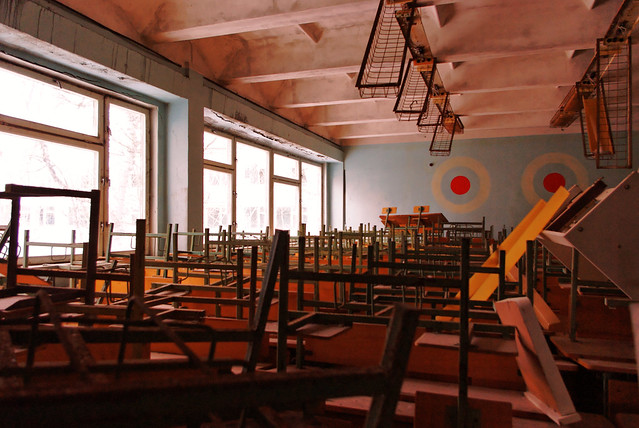
Do not reproduce in whole or part without permission of the Copyright holders.